How continuous telemetry across AI observability, autonomy, and governance can give brokers and underwriters greater clarity
Every major technology shift has forced the insurance industry to rethink how risk is measured. The internet created cyber risk. Cloud computing transformed infrastructure. Now artificial intelligence is changing decision-making itself.
Organizations of every size are deploying AI across customer service, finance, software development, human resources, legal operations, and countless other business functions. AI is no longer a future technology or isolated experiment. It is becoming part of the operational infrastructure of the modern enterprise.
For AI risk assessment, selection, and pricing, this shift raises a fundamental question: How do you continuously measure the risk created by systems that learn, evolve, and increasingly act on behalf of an organization?
The challenge is not simply determining whether a company uses AI. It is understanding how its AI systems operate, what data and permissions they have, which decisions they influence, how much autonomy they possess, and how those conditions change over time.
In a recent blog, Jack Kudale discussed why AI should not be viewed as a completely separate insurance peril. Instead, it is an extension of modern cyber risk that introduces new dimensions of operational exposure. Understanding those dimensions requires continuous observation, measurement, and governance.
That belief has led us to what we see as an important step forward for specialty insurance.
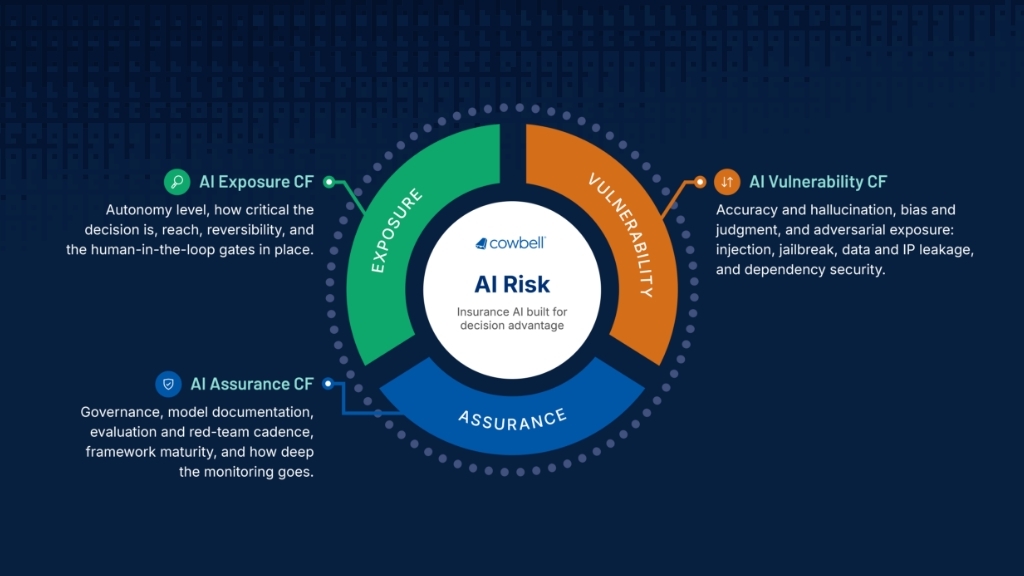
Today, Cowbell is introducing three new AI Cowbell Factors™, expanding our patented continuous risk-rating framework from eight factors to eleven and establishing a new way to measure enterprise AI risk.
The new Cowbell Factors assess three dimensions that increasingly define responsible AI deployment: AI Observability, AI Autonomy, and AI Governance. Together, they create a continuously updated posture score designed to help brokers, policyholders, and underwriters understand AI risk with greater clarity.
AI Doesn’t Just Add Risk. It Changes How Risk Behaves.
Cyber underwriting advanced when the industry developed better ways to observe digital risk as it changed. Continuously updated security signals gave insurers a more current view of an organization’s technology environment and the controls protecting it.
Artificial intelligence represents another inflection point, but measuring AI requires a different lens.
Generic large language model benchmarks can provide useful information about how a model performs under defined conditions. They reveal far less, however, about how an AI application behaves inside a live enterprise environment.
Using model benchmarks alone to evaluate enterprise AI risk is like reading an engine blueprint to predict whether a driver will have an accident. The engine matters, but so do the driver, the road conditions, the vehicle’s maintenance, and how the vehicle is being used.
The same principle applies to AI.
Business risk does not originate from the foundation model alone. It emerges from how an organization configures its AI systems, the permissions those systems inherit, the data they access, the decisions they make, the people supervising them, and the business processes they influence.
Two organizations can use the same underlying model and have substantially different risk profiles. One may limit the model to drafting internal content that is reviewed by an employee. Another may connect it to sensitive customer data or allow it to initiate transactions, modify software, or make consequential decisions with limited human intervention.
As AI applications gain access, authority, and autonomy, the application layer becomes a distinct risk vector. That exposure deserves to be measured directly.
Three Dimensions of Enterprise AI Risk
Every enterprise AI deployment ultimately raises three fundamental questions:
Can the organization see what its AI systems are doing? Can it trust how those systems perform? And can it demonstrate that AI is being governed responsibly?
Those questions became the foundation for three new AI Cowbell Factors™.
AI Exposure Cowbell Factor (CF) for Observability
AI Exposure CF measures an organization’s visibility into its AI ecosystem.
As AI adoption expands, organizations may struggle to maintain an accurate picture of which models are operating, which teams are using them, what data they can access, and which business processes they support. This lack of visibility can make it difficult to identify emerging exposures, assign accountability, or determine where additional controls are needed.
The AI Exposure CF examines the organization’s ability to identify deployed models and applications, understand their operational reach, and assess the significance of the decisions they influence. It also considers the level of human oversight surrounding those decisions, including whether outputs can be reviewed, interrupted, or reversed.
Higher levels of autonomy combined with higher-impact decisions naturally increase exposure. An AI assistant that recommends draft language to an employee presents a different risk profile from an agent that independently executes financial transactions, approves customer requests, or modifies production code.
Observability makes those differences visible and measurable.
AI Vulnerability Cowbell Factor for Autonomy
AI Vulnerability CF evaluates how safely and reliably AI systems perform within their intended operating environments.
As systems gain greater authority, their reliability becomes increasingly important. An inaccurate output may be relatively contained when it is reviewed by a knowledgeable employee. The same output could create a much larger exposure when an autonomous system can act on it without sufficient oversight.
The AI Vulnerability CF considers historical model performance and operational reliability. It incorporates indicators such as hallucination rates, algorithmic bias, adversarial robustness, susceptibility to prompt injection, data leakage, intellectual property exposure, and upstream dependency risk.
Third-party dependencies are particularly significant. Many enterprise AI applications rely on external models, data sources, plug-ins, application programming interfaces, and other services. Changes or failures within those components may alter how an application behaves, even when the organization has made no direct change to its own environment.
The Factor therefore moves the conversation beyond whether AI is present. It evaluates how much authority an AI system has, whether it performs reliably, how well it withstands manipulation, and whether it protects sensitive information while carrying out its intended function.
AI Assurance Cowbell Factor (CF) for Governance
Strong AI governance reduces uncertainty by demonstrating that an organization has established clear discipline around how AI systems are selected, deployed, monitored, and managed.
The AI Assurance CF evaluates documentation, red-team testing, model lifecycle management, access controls, policy enforcement, auditability, and broader governance processes. It also considers alignment with recognized frameworks, including the NIST AI Risk Management Framework and ISO/IEC 42001.
Effective governance extends throughout the AI lifecycle. It includes processes for approving new use cases, defining acceptable applications, assigning accountability, monitoring model performance, managing material changes, responding to incidents, and retiring systems that no longer meet the organization’s operational or risk requirements.
Governance also creates evidence. When policies, testing results, approval decisions, system changes, and exceptions are documented, organizations are better positioned to demonstrate that AI is being managed intentionally.
Organizations with mature governance practices can provide stronger assurance signals that appropriately reduce uncertainty within their overall risk posture. Responsible AI becomes measurable rather than merely aspirational.
Continuous Measurement Requires Continuous Telemetry
Enterprise AI environments can change quickly. Models evolve, permissions expand, agents gain new capabilities, third-party dependencies are updated, and new data sources are connected. A system initially deployed as an employee-assistance tool may later become integrated into sensitive workflows or gain the ability to take actions independently.
Each of these changes can affect an organization’s risk profile.
Point-in-time assessments remain useful, but they cannot fully capture how an AI environment develops between assessment periods. Meaningful measurement requires visibility into the operational signals that indicate when exposure, vulnerability, or governance conditions have changed.
To provide that visibility, Cowbell is introducing dedicated AI Connectors.
Just as our platform continuously monitors cloud infrastructure and digital attack surfaces, AI Connectors securely collect telemetry from enterprise AI environments. This allows AI Cowbell Factors™ to evolve alongside the technologies they measure.
The resulting signals can help underwriting better understand where AI is operating, how systems are being used, which controls are in place, and how an organization’s AI posture is changing.
This creates a more current and contextual view of enterprise AI risk—one grounded in the way intelligent systems actually operate within the business.
A Better Conversation for Cyber and Specialty Lines Brokers
The value of this technology ultimately lies in the conversations it enables.
As AI adoption accelerates, brokers are increasingly being asked questions that did not exist just a few years ago. How does AI affect our cyber exposure? Will our use of AI influence insurance pricing? Are we deploying AI responsibly? What controls should we prioritize? How can we demonstrate that our AI environment is well managed?
Until now, answering those questions has often required broad generalizations. AI Cowbell Factors™ provide a common language that can transform those conversations into more measurable and actionable discussions.
Brokers can help clients understand how AI contributes to their overall risk profile and distinguish among the different sources of exposure. Limited visibility may indicate an observability concern. Excessive system authority or inconsistent performance may point to autonomy risk. Incomplete controls and unclear accountability may indicate opportunities to strengthen governance.
This framework also creates a clearer path from risk identification to risk improvement. Brokers can help organizations prioritize practical measures, demonstrate progress, and explain how stronger operational practices may improve resilience and insurability over time.
That elevates the broker’s role beyond policy placement. It strengthens the broker’s position as a trusted advisor helping organizations navigate one of the most significant technology transitions in decades.
A New Chapter for Underwriting Intelligent Systems
Cyber insurance matured as the industry developed the ability to measure digital risk with greater frequency, context, and precision. We believe artificial intelligence represents the next evolution of that discipline.
AI Cowbell Factors™ are more than three additional underwriting signals. They establish an underwriting approach for intelligent systems grounded in continuous telemetry, transparent measurement, and responsible governance.
As AI becomes embedded across every business function, insurers need to understand more than which tools an organization uses. They need visibility into how those systems behave, what data and permissions they possess, which decisions they influence, how much autonomy they have, and how effectively they are governed.
The future of underwriting intelligent systems depends on measuring them as they operate. By bringing observability, autonomy, and governance into a continuously updated risk framework, the industry can move toward a clearer and more confident understanding of enterprise AI exposure.
That’s The Sound Approach to Risk.